Trusted by over 50,000 companies worldwide
Microsoft
One ERP for finance, sales, supply chain, and operations, implemented, migrated, and supported by a Microsoft-certified team that knows Canadian businesses inside out.
Break down data silos, cut manual work, and run your business from anywhere with Dynamics 365 Business Central, implemented and supported by a team that sticks around after go-live.
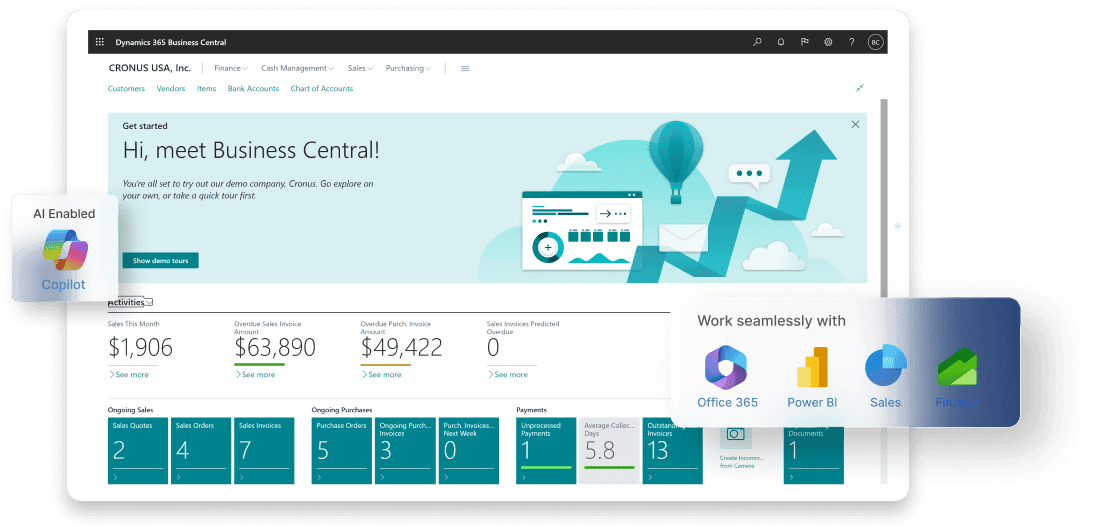
Dynamics 365 Business Central is Microsoft's cloud ERP for small and mid-sized businesses. It connects your finance, sales, inventory, and operations in one system, so your team works from one set of numbers instead of five disconnected tools. It's the modern, AI-powered successor to Microsoft Dynamics NAV.
Getting it right depends less on the software than on who sets it up, who trains your team, and who picks up the phone when something breaks, and that's been Dynamics Square's job in Canada for over 15 years now.
We're a Microsoft Solution Partner with 150+ certified consultants, and we've run this process for 350+ businesses across Canada and North America.
Wherever you're based, be it Toronto, Winnipeg, Vancouver, or anywhere in between, the fastest way to find out if Business Central fits your business is to tell us what's slowing you down right now. Book a call and figure out how to amplify your business.
Trusted by over 50,000 companies worldwide
Microsoft
209% ROI over 3 years from Business Central implementations
Forrester Consulting, Total Economic Impact™ of Microsoft Business Central (March 2026)
30% reduction in closing activities
Available in 242+ countries
350+ successful implementations delivered by Dynamics Square Canada
Dynamics Square data
150+ Microsoft-certified consultants on our bench
Cloud ERP market to reach $172.74B by 2029 | 14.5% CAGR
Get holistic visibility, real-time insights, and an impactful customer experience to achieve business goals with Microsoft Dynamics 365 BC.
Connect your entire business processes, make smarter decisions, and start growing easily with game-changing Business Central capabilities. Explore what Business Central manages across your business. Click into any department below.
Manages internal financial transactions without any errors.
Estimates future cash inflows, outflows, and financial position.
Plans and tracks financial resources to control expenses.
Track inventory value to forecast expenses and maintain inventory levels.
Combines financial data from multiple entities to analyze finance.
Allocate expenses and revenues accurately using a common journal.
Manage cash instruments, offering visibility and control over finance.
Tracks and manages incoming payments and settles customer accounts.
Tracks and manages outgoing payments to suppliers and vendor partners.
Manage and track long-term assets, including maintenance costs and insurance policies.
GST/HST filings, CRA payroll remittances, or WSIB reporting, if you get any of these wrong, it's not a software problem. It's an audit problem. Dynamics Square configures Business Central to handle this correctly from day one:
Automatic calculation, tracking, and remittance-ready reporting across provinces.
Connect payroll processing directly to CRA reporting requirements
Native support for Canadian banking formats and electronic funds transfer
Built-in tracking to keep workplace safety insurance reporting audit-ready
If you're already moving to Business Central from NAV, GP, Sage, or another system, you have two paths. Choosing the wrong path costs time and money, so here's the breakdown.
Not sure which one fits? That's exactly the kind of question a 30-minute call answers faster than a comparison table ever will.
Get a Free Migration Path AssessmentEvery Business Central implementation at Dynamics Square Canada follows Success by Design. It is Microsoft’s own framework, built from thousands of real Dynamics 365 projects and used by Microsoft's FastTrack team on its most complex deployments. Five phases, each with a clear checkpoint before the next one starts:
We sit down with your team, gather your actual business requirements, and validate the case for what you're building before a single configuration decision gets made.
Every workstream gets scoped in writing, such as what's in, what's out, and who owns what, so nothing gets discovered halfway through the build.
Our consultants configure and build Business Central against the agreed design, with structured checkpoints built in to catch problems while they're still cheap to fix.
Full testing, user training, and a formal go-live readiness review. We don't flip the switch until that review says you're ready, not before.
You're live, and we stay on to stabilize the system, resolve what comes up, and plan what's next instead of moving on to the next contract.
Whether you're moving off an outdated accounting tool or leaving behind a partner who's stopped returning calls, Business Central gives you a cleaner, faster foundation.
 Business Central
Struggling with data silos, downtime, or system complexity?
Plan Your NAV Migration
Centralized financial visibility across finance, purchasing, sales, and fixed assets, faster reimbursements, and a finance team that finally has time for budgeting instead of data entry.
A non-profit health centre serving multiple Ontario locations was buried in manual expense spreadsheets and disconnected Sage 300 workflows, with a finance team of just two to three people trying to keep up.
Dynamics Square Canada implemented Business Central with Continia Document Capture and Continia Expense Management, and integrated ADP payroll, replacing manual entry with automated vendor invoicing and digital expense submissions.
Read the Full Case Study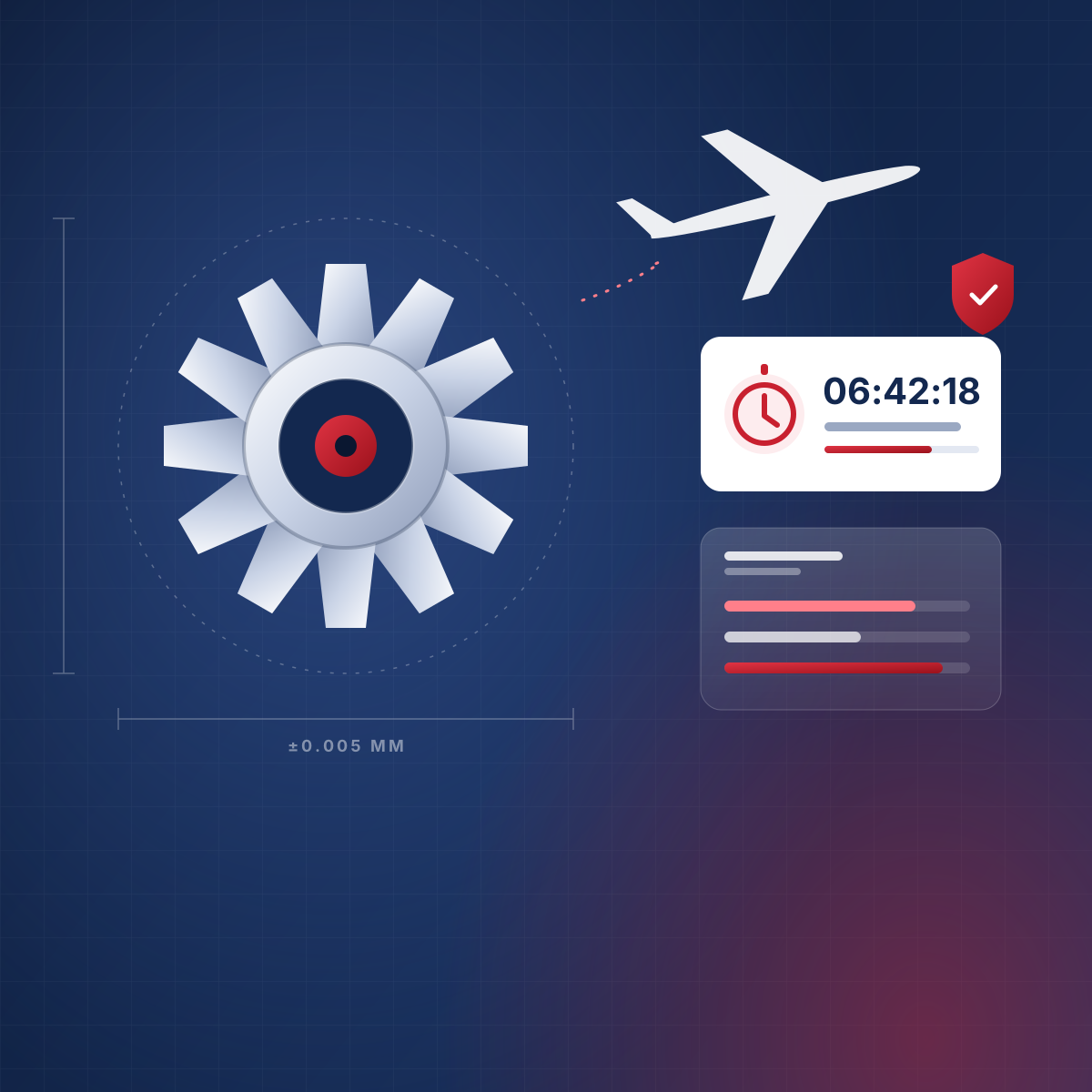
Real-time inventory and supply chain visibility, accurate shop-floor time tracking, and one less unreliable third-party system to manage.
A 30-year manufacturer of high-precision parts for Defense, Aerospace, and Medical clients had outgrown NAV 2013. The inventory valuation was unreliable, shop-floor time tracking didn't exist, and a third-party measurement tool kept breaking. Dynamics Square migrated their data to Business Central Online and built a custom Time Collection Module, integrated directly with BC.
Read the Full Case StudyPrices below reflect Microsoft's suggested retail pricing (MSRP) in CAD in 2026. Your actual cost depends on users’ mix (number of licenses), add-ons, and implementation scope. We'll build you an exact quote in one call.
Take a look at Dynamics 365 Business Central Pricing and choose the perfect plan among Team Member, Essential, and Premium Licensing options.
Dynamics 365 Business Central
From $108.50 CAD per user/month
Dynamics 365 Business Central
From $149.20 CAD per user/month
Dynamics 365 Business Central
From $10.90 CAD per user/month
The right technology empowers you and sets your business up for the future. Dynamics Square helps your business get the edge it needs to thrive and succeed.
Book a Free Consultation TodayCompanies choose us as a Dynamics 365 support partner due to reliable service, trust, competitive pricing, etc. Here are a few points that make us favorites:
We tailor Business Central with our expert team to fulfill your unique business requirements, exceeding customer expectations and meeting market demands.
We are a team of over 150+ Microsoft-certified Dynamics 365 consultants. At Dynamics Square, the best industry minds are on your side to tackle any challenge and craft growth-oriented strategies.
We have adequate resources and infrastructure to empower businesses of all sizes. With our robust Dynamics 365 Business Central support services, you can match your ambition to scale.
We offer on-site support for complex problems or interruptions to ensure your company gets back on track quickly and affordably.
Business Central is primarily an ERP system as it manages finance, inventory, supply chain, and operations. It does include built-in CRM-style capabilities (contacts, sales opportunities, customer management), which is why many small and mid-sized businesses use it as their only business system rather than running separate ERP and CRM platforms.
No. Dynamics 365 is Microsoft's umbrella brand for its business applications. It includes Business Central alongside separate products like Dynamics 365 Sales, Customer Service, and Finance & Operations. Business Central is the ERP product within that family, purpose-built for small and mid-sized businesses.
Business Central gives smaller teams enterprise-level visibility without enterprise-level complexity: one system for finance, supply chain, sales, and reporting; native Microsoft 365 integration; availability in 242+ countries and currencies; and built-in Copilot AI assistance.
Business Central is the modern, cloud-based successor to Dynamics NAV (Navision), built on the same core application logic with a modern interface, regular Microsoft-managed updates, and expanded capabilities. NAV customers can still get support, but Microsoft has moved mainstream investment to Business Central.
According to Forrester Consulting's Total Economic Impact™ study, organizations can see a 209% ROI over three years, along with up to a 30% reduction on closing activities.
View the Forrester study →It depends on how customized your current system is and whether your priority is speed or process improvement. Lightly customized systems are often better suited to a direct upgrade; businesses looking to fix long-standing process problems usually benefit more from a re-implementation.
See the full comparison above ↑Most implementations take 3 to 8 months depending on complexity, modules, and customization needs. Licensing starts as shown in the pricing table above; total project cost depends on your specific requirements.
Get a custom quote →Yes, Business Central includes Microsoft Copilot, which provides AI-assisted insights, automates routine tasks, and supports natural-language interactions across the system.
Yes, Power BI reporting and visualization are already built into Business Central. Additional third-party integrations (like Salesforce) are also supported.
Business Central is designed for small to mid-sized businesses with core ERP needs. Finance & Operations (now split into Dynamics 365 Finance and Supply Chain Management) is built for larger enterprises with complex, high-volume, multi-entity operations.
See the full comparison →We serve businesses across Canada from our Ontario and British Columbia offices, with clients in Toronto, Thornhill, Vancouver, Winnipeg, Montreal, Quebec City, and beyond.