Designed to streamline business processes of small and medium-sized businesses, Microsoft Dynamics 365 Business Central is a strong tool for business management. Among the most interesting features is Assisted Setup in Business Central, which simplifies the configuration process and enhances the onboarding experience.
Whether you're starting a new company, compiling financials, or integrating with other apps, Business Central Assisted Setup leads you through the process without complexity.
Table of Contents
- What is Assisted Setup in Business Central?
- Key Components of Business Central Setup
- What Are the Benefits of Using Assisted Setup?
- Key Areas Where Assisted Setup is Applicable
- How to Access Assisted Setup in Business Central
- Practical Example: Setting Up a New Company
- Assisted Setup vs. Manual Setup in Business Central: What's the Difference?
- Exploring the Limitations of Assisted Setup
- Role of Dynamics Square in Business Central Implementation
- Frequently Asked Questions
What is Assisted Setup in Business Central?
Assisted Setup in Business Central is a built-in list of setup wizards. Each wizard walks an administrator through one task, such as creating a company, setting up email, turning on approval workflows, or importing customers and vendors. Finished guides are marked Completed. Anything without a guide is set up manually.
Key Components of Business Central Setup
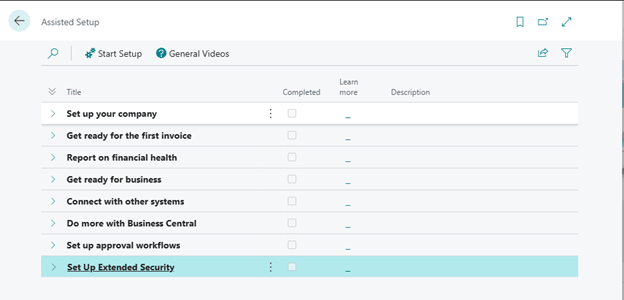
Wizard Pages: The Business Central wizard page is a methodical, step-by-step guide that walks users through setup chores, therefore guaranteeing that all required configurations are handled.
Navigate Page Type: Dynamics 365 Business Central's Navigate Page type lets users enter data and easily traverse the setup of multi-step workflows.
Customization Options: Users can customize some setup actions to fit business-specific needs, therefore offering flexibility outside of standard procedures.
What Are the Benefits of Using Assisted Setup?
User-Friendly Guidance: By guiding users through each stage of the configuring process, assisted setup wizards help to lower the possibility of mistakes and guarantee that all required data is recorded.
Time Efficiency: Following standardized procedures helps users finish setups faster than with predefined settings, enabling companies to start more rapidly.
Consistency: Standardized set-up procedures guarantee that configurations match best practices, therefore fostering consistency throughout the organization.
Reduced Need for Technical Expertise: Even users without strong technical understanding can boldly set the system, hence democratizing the setup process and lowering dependency on specialist staff.
Key Areas Where Assisted Setup is Applicable
Company Creation: The Assisted Setup guide helps specify foundational data, including company information, address details, and financial settings when establishing a new company within Business Central. This ensures that all critical parameters are set correctly from the outset.
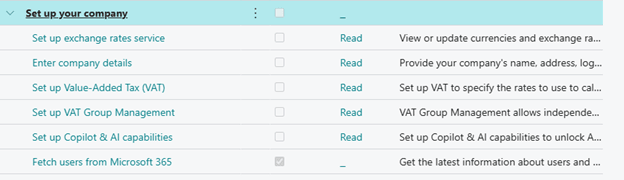
Financial Management: Assisted Setup makes configuring basic financial components such as the general ledger, chart of accounts, and tax settings simple. The wizard makes sure financial systems are fit for the needs of the company.

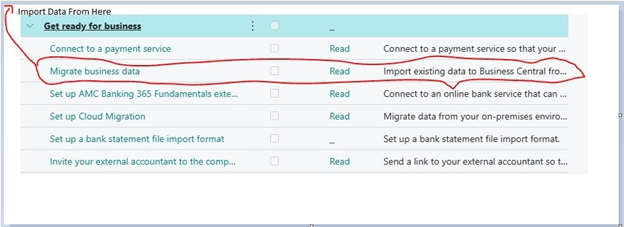
Data Migration: Moving data from legacy systems into Business Central can present challenges. Assisted Setup offers solutions to effectively map and import data, therefore reducing disturbance during the transition.
Module Configuration: Specific modules, such as sales or inventory control, can be configured with specialized Assisted Setup guidelines. These wizards guarantee that every module is set up to efficiently meet the operational demands of the company.
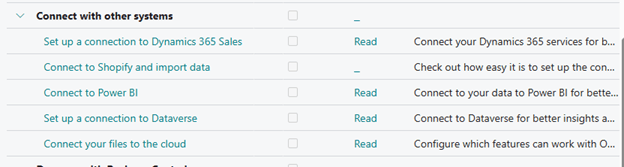
For instance, you can integrate D365 Sales with Business Central, initiate Shopify integration, and connect with Power BI using Assisted Setup.
In addition, you can also go for Dataverse connection setup that will enable you to connect with your intended application without intervening into Business Central data. The successful connection with Dataverse offers you a single source of truth and stores all data. You can enable one- or two-way synchronization as per your requirements.
How to Access Assisted Setup in Business Central
There are three ways to do it. Pick whichever is fastest for you.
Search: Press Alt+Q (or select the search icon), type "Assisted Setup," and choose the link.
Settings menu: Select the gear icon, then Assisted Setup.
Get Started checklist: On a first sign-in or a new company, the checklist points you to the setup steps that apply to your country or region.
Then work through it like this:
Find the guide you need. The page shows each guide with its status.
Select it to open the wizard.
Go through each step and fill in the fields. Most have tooltips if you are unsure what a field means.
Finish on the last page. The guide should now show as completed.
Check the result. Open the related setup page or, for company details, Company Information, and confirm the values are what you intended. A completed wizard is not proof that the data is right.
Practical Example: Setting Up a New Company
The Assisted Setup guide provides templates to fit various purposes when starting a new company:
Evaluation (Sample Data): Ideal for exploring Business Central's capabilities with pre-populated sample data.
Production (Setup Data Only): Provides a clean slate with essential setup data, allowing businesses to input their actual operational data.
Create New (No Data): Offers a completely blank setup for organizations that prefer to configure every aspect from scratch.
Assisted Setup vs. Manual Setup in Business Central: What's the Difference?
Assisted setup covers a handful of common tasks. Everything else lives under Manual Setup, which you reach from the gear icon, then Advanced Settings, then Manual Setup. Microsoft's own guidance is to use a guide where one exists and go manual only where it doesn't.
| Area | Assisted setup can help with | Usually needs manual or consultant work |
| Company | Creating the company, loading basic setup data | Multi-entity structure, intercompany, dimensions that match how you report |
| Financial configuration | A starter chart of accounts and posting setup from the company template | Redesigned chart of accounts, posting groups, tax setup, bank reconciliation rules, fiscal periods |
| Data migration | Importing customers, vendors, and items from Excel or QuickBooks | Opening balances, open invoices, history, anything from Sage, NAV, or GP (see our Sage migration guide) |
| Workflows | Simple approvals for items, customers, and payments | Multi-level approvals, conditions tied to roles, anything custom |
| Integrations | Email, Dynamics 365 Sales connection, reporting data | Shopify, EDI, banks, payroll, third-party apps, custom APIs |
| Custom requirements | Not covered | Extensions, industry rules, reports, permission design |
Exploring the Limitations of Assisted Setup
While Assisted Setup simplifies many processes, it does have some limitations:
Not all configurations are automated, and some advanced setups still require manual intervention.
It offers flexibility, but highly complex workflows may need additional scripting or third-party extensions.
Certain industries may require additional configuration beyond what Assisted Setup offers.
Role of Dynamics Square in Business Central Implementation
Dynamics Square, a Microsoft Dynamics Partner, plays a crucial role in streamlining Business Central implementation. Our team assists organizations across Canada in configuring Business Central wizard pages, ensuring that Assisted Setup in Business Central 365 is tailored to specific business needs.
Nevertheless, with expertise in Business Central API integrations, we help Canadian businesses optimize their ERP adoption.
If you are looking for a Business Central partner in Canada, Ontario, Toronto, or British Columbia, we can run the guides with you, then handle what they don't: tax setup, chart of accounts, migration, and integrations.
In case you are stuck in an unresolved query, please get in touch with our Microsoft-certified consultants.
Frequently Asked Questions
Assisted Setup in Business Central is a set of built-in wizards that guide you through common setup tasks such as creating a company, configuring email, adding approval workflows, importing data, and connecting Dynamics 365 Sales.
Press Alt+Q, type Assisted Setup and choose the link. You can also select the gear icon and then Assisted Setup.
Company creation, email, approval workflows, data migration from Excel or QuickBooks, the Dynamics 365 Sales connection, external accountant access, cash flow forecast, and reporting data. The list depends on your role, region, and experience.
Yes, the Create New Company guide, opened from the Companies page, offers evaluation, production (setup data only), and blank templates. It sets up the basics. Canadian tax, chart of accounts, and workflows still need configuring.
A very small business with simple needs can run the wizards and learn as it goes. Once you have tax groups across provinces, migration, integrations, or approvals, a partner usually saves more on rework than it costs.
Check your role and permissions, the company's experience (essential or premium), and your region. If no guide exists for the task, use Manual Setup under Advanced Settings or ask your partner.