Business Central ERP : What it is, Pricing, Capabilities | 2026
Deciding which ERP among various solutions like Dynamics 365 Business Central, Dynamics 365 Supply Chain, or other business management modules in Microsoft Dynamics 365 can be a cornerstone for your business. It is as difficult as searching for a lost needle in a haystack.
Whether it's Oracle NetSuite, SAP Business One, Sage Intacct, Sage 50, Sage 300, QuickBooks, Workday Financial Management, Microsoft Dynamics 365, plenty of ERP vendors claim to be the best fit
But the honest answer is the popularity of different ERP software can vary depending on factors:
- The size of the company
- The specific industry the company operates in, and
- The company's specific needs.
This article is about one of those options: Microsoft Dynamics 365 Business Central. What it does, what it costs for a Canadian business in 2026, how an implementation typically plays out, and how companies migrate onto it from systems like Microsoft Dynamics NAV, Microsoft Dynamics GP, QuickBooks, or Sage.
According to Forrester, Business Central from Dynamics 365 can be the right choice if you're looking to obtain everything to manage the operations of a small or medium-sized business.
In Canada, many organizations from different industries are already using this profit-thriving modern ERP solution. Read the stats here: Insights for the Use of Dynamics 365 in Canada
Before diving into the details, first let’s understand what Business Central exactly is.
What is Dynamics Business Central?
Dynamics 365 Business Central (formerly Dynamics NAV, or Navision, before Microsoft rebuilt it for the cloud) is an all-in-one ERP that manages your financials, supply chain, sales, purchasing, and projects from a single platform. That means it's accessible from anywhere, on any device.
Business Central also includes basic CRM capabilities like contact and opportunity tracking that covers what many small businesses need. If your sales team needs a dedicated, full-featured CRM, Business Central connects natively with Dynamics 365 Sales for that.
Nevertheless, what Business Central itself is built to do, and does well, is run the operational and financial backbone of a growing business, including general ledger, accounts payable and receivable, inventory, purchasing, warehouse operations, project costing, and, for manufacturers, production planning.
Across Canada, organizations of varying sizes rely on Microsoft ERP to replace a patchwork of spreadsheets, accounting software, and disconnected point solutions with one system that everyone works from.
Capabilities of Business Central
Financial management: General ledger, accounts payable and receivable, fixed assets, bank reconciliation, cash flow forecasting, budgeting, and multi-currency and multi-entity consolidation. For Canadian businesses, this includes configurable tax handling for GST/HST and PST across provinces, which matters if you operate in more than one jurisdiction.
Supply chain and inventory management: Real-time inventory visibility, automated reordering, warehouse management, item tracking (lot and serial numbers), and demand forecasting, built to reduce both stockouts and excess inventory sitting on shelves.
Manufacturing (Premium tier): Discrete and process manufacturing support, including production orders, bills of materials, capacity planning, and machine centre scheduling.
Sales and purchasing: Quote-to-cash and requisition-to-pay workflows, along with basic opportunity and contact management for businesses that don't need a full CRM layered on top.
Project management: Job costing, resource planning, time tracking, and budget-to-actual reporting for project-based businesses; professional services firms and construction contractors tend to lean on this heavily.
Service management (Premium tier): Service orders, contracts, dispatching, and equipment or item tracking for businesses running field service or maintenance operations.
Warehouse and distribution: Bin and location tracking, pick and put-away workflows, and shipping management for businesses with more than a single storage location.
Features of Business Central
Business Central is a comprehensive business management solution. Some of the key features of Business Central include:
Business Central API: A REST/OData-based API lets developers build custom integrations, connect e-commerce platforms, or pull data into external reporting tools without relying on manual exports. This is the same API layer that most Business Central apps on Microsoft AppSource are built on.
Business Central with Power BI: Power BI is natively embedded, so dashboards and reports run off live data straight from the ERP instead of a static Excel export that's outdated the moment it is created.
Business Central Dataverse integration: Through virtual tables and the Business Central connector for Power Platform, data in Business Central can be surfaced directly in Dataverse, useful for businesses that also run Power Apps or Dynamics 365 Sales and want a single data model across both.
Business Central assisted setup: First-time configuration is guided through assisted setup wizards that walk you through company information, chart of accounts, opening balances, and core settings, rather than dropping you into a blank system with no starting point.
Copilot and AI features: Microsoft has continued rolling Copilot-assisted capabilities into Business Central, including late-payment prediction, demand forecasting, and AI-assisted data entry, aimed at reducing repetitive manual work in finance and operations.
Role Centres: Each user's home page is tailored to their role. A warehouse manager sees different data and shortcuts than a controller does, so people are not wading through features irrelevant to their job.
Extensions and AppSource: Because customizations are built as extensions rather than direct code changes, businesses can add industry-specific functionality like Insight Works, Tasklet, and more without breaking their ability to receive Microsoft's regular updates.
Mobile app: Native mobile access lets field staff, warehouse teams, and managers check data or approve transactions from a phone, which is a real gap in older desktop-based ERPs.
Key Benefits of Dynamics 365 Business Central
Lower total cost of ownership over time: No server hardware, no periodic version-upgrade projects, and fewer separate licenses for BI or mobility, since those are built into the subscription.
Faster decisions with live data: Embedded Power BI means leadership is looking at where the business stands today, not where it stood at last month's close.
Room to grow without a re-platform: Adding users, companies, or new business lines does not force a hardware upgrade or a fresh implementation the way scaling an on-premises system often does.
Less manual, repetitive work: Automation and Copilot-assisted entry cut into the reconciliation and data-entry hours that eat up finance and operations teams in older systems.
One system instead of several: Finance, inventory, sales, and (on Premium) manufacturing run on a shared dataset, which removes the need for manual reconciliation between disconnected tools.
Easier multi-province compliance: Configurable GST/HST and PST handling by province reduces the manual tax setup that Canadian businesses operating in more than one region often must maintain themselves.
Predictable IT overhead: Automatic updates mean your team is not budgeting time for the next major version of migration; Microsoft rolls updates continuously as part of the subscription.
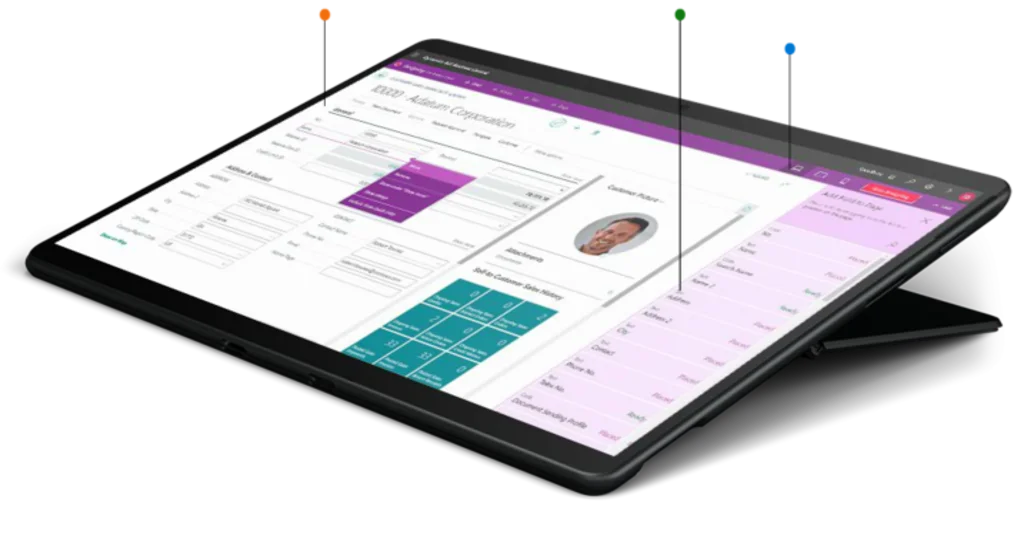
Integration of Business Central with other Dynamics 365 Applications and Office 365
Deployment model: Cloud vs On-Premises
This is worth being precise about, because the options have changed meaningfully in the last couple of years. As of April 1, 2025, Microsoft stopped selling new perpetual (one-time purchase) licenses for Business Central on-premises. If you are a new customer today, your choices are between the following:
Business Central Online (SaaS): The cloud subscription model, which is what Microsoft actively recommends and continues to invest most of its development effort into.
Business Central On-Premises Subscription: A subscription-based (not perpetual) license for businesses that need to keep the system on their own servers, often for data residency or specific compliance reasons.
If you already hold a perpetual on-premises license with an active enhancement plan, you are not affected; you can keep using it and continue adding users. But for anyone evaluating Business Central fresh in 2026, the "buy it once and own it forever" on-premises path Sage and older Dynamics products offered isn't on the table the same way it used to be.
For most Canadian businesses, cloud deployment ends up being the simpler and more cost-predictable route anyway. It means no server hardware to maintain, automatic updates, and built-in access to Copilot and other features Microsoft rolls out to the SaaS version first.
Licensing and Pricing of Business Central (2026)
Licensing is built around a few core tiers:
Business Central Essentials covers core financial management, sales, purchasing, inventory, and project management. It is priced at CA $108.50 per full user, per month, on an annual commitment, following Microsoft's pricing update that took effect in late 2025.
Business Central Premium includes everything in Essentials plus manufacturing and service management, priced at CA $149.20 per full user, per month.
Team member licenses give lighter, mostly read-only access, meaning approvals, time entry, and expense submission for around CA $10.90 per user per month. This is the license to use for staff who do not need full ERP access but still need to interact with the system occasionally.
Device licenses, useful for shared workstations in warehouses, start at around CA $54.30 per device, per month.
Business Central Canadian pricing comparison table:
| License Type | CAD (approx., per user/month) | Best fit |
|---|---|---|
| Essentials | CA $108.50 | Finance, sales, purchasing, inventory, no manufacturing |
| Premium | CA $149.20 | Adds manufacturing and service management |
| Team Member | $10.90 | Approvals, timesheets, light read access |
| Device (shared) | $54.30 | Shared warehouse or shop-floor terminals |
Business Central Implementation: Methods, Approach, and Timeline
Business Central is genuinely easy to use once it is set up—the interface is intuitive, and most staff pick it up quickly. Getting it configured correctly in the first place is where projects succeed or stall.
Most Microsoft partners, including Dynamics Square Canada, follow a phased implementation approach along these lines:
1. Discovery and planning (typically 1–3 weeks)
Define what you are trying to achieve, document current processes, and identify which modules and licenses fit into your business. This is also where legal entity setup, chart of accounts structure, and Canadian tax jurisdictions get scoped.
2. Solution design (2–4 weeks)
Map your current processes into Business Central's structure, decide what custom configuration needs versus standard functionality, and confirm the licensing mix (Essentials vs Premium and how many Team Member licenses you will need).
3. Configuration and build (3–8 weeks, depending on complexity)
Business Central gets configured to match your business, including companies, users, permission sets, approval of workflows, and manufacturing or project modules if you are on Premium. Any custom extensions or third-party integrations are built during this phase.
4. Data migration (runs in parallel with configuration)
Historical data gets extracted from your legacy system, cleaned, and loaded into Business Central in stages, then reconciled against the original records before anything is considered final.
5. Testing and validation (1–3 weeks)
The configured system gets tested against real business scenarios before anyone touches it in production, catching gaps while there's still time to fix them.
6. Training (1–2 weeks, often overlapping with testing)
Role-based training for finance, sales, warehouse, and production staff means each group learning the parts of the system relevant to their job rather than a single generic walkthrough.
7. Go-live and stabilization (2–4 weeks post-launch)
The system becomes the operational system of records, with close monitoring during the first few weeks to catch edge cases that inevitably surface once real transaction volume hits the new environment.
Note: For straightforward Essentials implementation with clean data, the full timeline often lands around 8 to 12 weeks. More complex projects like multi-entity, manufacturing on premium, or heavy customization commonly run 4 to 6 months. In addition, anyone quoting a Business Central implementation in a week or two for a business of any real size is skipping steps that tend to surface as problems later.
Business Central Migration
A Business Central migration is the process of moving your business data, configuration, and operational processes from an existing system into Business Central, as opposed to a brand-new implementation, where there is no legacy system to carry data over from.
Migration projects have their own considerations, meaning legacy data structures rarely map cleanly onto Business Central's, historical data needs a cutoff decision, and any customizations or integrations tied to the old system need a plan of their own.
The specifics of a migration depend heavily on where you are migrating from. Below we mentioned the four most common paths:
Dynamics NAV to Business Central Migration
Dynamics NAV to Business Central migration is generally the most straightforward path since Business Central is built on the same underlying foundation as Dynamics NAV. Most NAV customizations and much of the data structure carry over with far less rework than a migration from an entirely different platform. That said, older, heavily customized NAV environments, especially those running outdated versions, still require a proper assessment before jumping straight to the cloud, since Microsoft ended new perpetual on-premises purchases in 2025 and NAV itself is well past mainstream investment.
QuickBooks to Business Central Migration
QuickBooks is built for straightforward, small business accounting. Businesses generally move to Business Central once they have outgrown QuickBooks' capacity for multi-entity finance, real inventory management, or manufacturing needs QuickBooks was never designed to handle. QuickBooks to Business Central migration typically involves more process redesign than NAV migration, since QuickBooks and Business Central are structured quite differently under the hood.
Also Read: Business Central vs QuickBooks
Dynamics GP to Business Central Migration
Microsoft has been steering GP customers toward Business Central for several years, and as of April 1, 2026, new sales of Dynamics GP are limited to existing customers only means Microsoft is no longer onboarding new GP customers at all. For businesses still running GP, planning the migration from Dynamics GP to Business Central is no longer a question of 'if,' but 'when.'
The financial management structure in Business Central Essentials maps reasonably well to GP's core functionality, and businesses that need GP's manufacturing depth typically move to Premium.
Sage to Business Central Migration
Businesses running Sage 50, Sage 100, or Sage 300 typically migrate to Business Central once they need native manufacturing, deeper reporting through Power BI, or multi-province tax handling that Sage often requires manual workarounds or add-ons to manage. We have covered this migration path in detail, including a full step-by-step breakdown and a Sage vs Business Central comparison, in our dedicated Sage to Business Central migration guide.
Note: Across all four paths, the same principles apply, including not migrating every year of historical data by default; timing the cutover around your fiscal year rather than peak season or year-end close; and involving the finance and operations staff who will use the system in testing, not just IT.
Summarizing What You Went Through!
Dynamics 365 Business Central is a versatile, cost-effective, and comprehensive cloud ERP solution that is ideal for small or mid-sized businesses.
The solution is highly scalable, easy to use, and offers automation for many of the day-to-day manual tasks that small and mid-sized businesses must perform.
This includes automation for accounting, inventory management, and financial reporting.
With such an all-in-one business management cloud solution, your teams can focus on growing by managing your core business operations.
Moreover, Business Central gets flexibly integrated with other systems, such as CRM and e-commerce platforms like Dynamics 365 for Sales, to streamline sales operations and improve marketing with Dynamics 365 Marketing.
Additionally, since Business Central is a cloud-based ERP solution, you can access data and systems from anywhere, anytime. And Microsoft D365 Business Central can be implemented for a fraction of the cost of larger enterprise systems.
This solution also drops the need for multiple systems and software, which can help you save tons of costs, making it a great option for all small or mid-sized businesses in 2026 and beyond.
For more information, feel free to contact Dynamics Square Canada via call at +1 778 381 5388 or drop an email at info@dynamicssquare.ca.
.jfif)
Himank Kochar is a technical content writer at Dynamics Square. With a passion for writing and technology, he focuses on creating clear and informative blogs for readers. He enjoys breaking down complex topics into simple, easy-to-understand ideas. He believes in writing content that adds real value and helps readers make informed decisions.