Why Fashion and Apparel Manufacturers Trust Us
60+
Implementations in Manufacturing
35+
Manufacturing and Supply Chain Consultants
14+
Years Serving Canadian Manufacturers

Business Central or Supply Chain Management for Fashion and Apparel Manufacturing
Dynamics Square recommends two Dynamics 365 ERP solutions for fashion and apparel manufacturers: Business Central for simpler operations and Supply Chain Management for larger, more complex businesses.

Dynamics 365 Business Central
Dynamics 365 Business Central suits private label manufacturers, uniform and workwear makers, activewear and outerwear brands, and direct to consumer labels operating across a few production facilities. Key features include size and colour variants, production bills of materials with fabric waste allowances, production steps and timings, subcontractor management, and sales forecasting to support stock replenishment.
Explore Business Central
Dynamics 365 Supply Chain Management
Dynamics 365 Supply Chain Management is meant for wholesale clothing suppliers, multi brand groups, and manufacturers operating factories across several regions or countries. Key features include advanced product variations, bulk variant creation, master production planning, demand forecasting, subcontractor tracking, and advanced warehouse management for complex inventory and fulfilment needs.
Explore Supply Chain ManagementWhat Compliance Requirements Must Fashion and Apparel Manufacturing ERP Meet in Canada?
Fashion and apparel manufacturers in Canada need accurate records for textile labels, fibre content, product safety, import checks, and supply chain reporting. A suitable ERP helps organise product details, supplier information, and material records to support these requirements.
Textile labelling requirements
Consumer textile products generally need labels identifying the fibres they contain. Each fibre making up at least five per cent of the total fibre mass must be listed by its generic name and percentage. Labels must also identify the dealer through a name and mailing address or a CA Identification Number. Required information must remain legible, and any care instructions provided must be accurate.
Bilingual labels and country of origin
Textile labels generally need fibre names and content in both English and French, with additional rules potentially applying in Quebec. Imported products must also show their country of origin in English or French. ERP records can help teams maintain consistent fibre details, supplier information, and origin data across product ranges.
Children's sleepwear safety
Children's sleepwear must meet Canadian flammability requirements, with different tests for loose fitting and close-fitting garments. Certain loose-fitting garments treated with flame retardants also need permanent bilingual labels and care instructions. ERP records can help teams link garment styles to fabric details, test results, and required labels.
Forced labour import restrictions
Canada prohibits importing goods made wholly or partly through forced labour. Fashion businesses need visibility into their suppliers, fabric sources, and manufacturing locations to help identify supply chain risks. ERP records can support this tracking, although they do not by themselves prove that products comply with import rules.
Forced labour and child labour reporting
Certain businesses must publish annual reports explaining the steps they take to address forced labour and child labour risks in their supply chains. These reports cover supplier relationships, risk assessments, prevention measures, and staff training. ERP records can help teams identify suppliers, trace materials, and gather information for reporting.
What Dynamics 365 ERP for Fashion and Apparel Manufacturing Needs to Do
An apparel ERP should help teams quickly trace a short shipment to the missing size, cutting order, fabric lot and subcontractor. The following capabilities help manufacturers connect production, inventory and order information to resolve problems faster.
Styles, colours and sizes
Business Central tracks style variants by colour and size using codes across sales, purchasing and inventory. It supports variant pictures, attributes, mandatory variant selection and location specific reorder rules. Supply Chain Management supports five product dimensions and suggests combinations for inventory tracking.
Fabric, trims and dye lots
Fabric, thread, zippers, buttons, labels and polybags need separate inventory records. Lot numbers distinguish dye batches, while batch attributes track shade, width and shrinkage. Supply Chain Management can reserve fabric by these attributes, helping cutting orders use matching shades.
Bills of materials and cutting yield
A bill of materials lists fabric, lining, trims, labels and packaging for each style. Versioning supports seasonal changes, scrap allowances account for cutting waste, and variant specific material quantities accommodate larger sizes. Business Central assembly BOMs also support kits and size assortment prepacks.
Cut and sew production planning
Production orders track spreading, cutting, sewing, pressing, finishing and packing. Routings define operations and expected times, while MRP and master planning use orders, forecasts, inventory and supply information to plan material purchases and production schedules around shipment dates.
Subcontractors and contract sewing
Business Central supports subcontracted routing operations through vendor linked work centres, purchase orders and transfer orders for cut parts and sewn garments. Supply Chain Management can generate subcontracting purchase orders, track outside jobs and print delivery notes. Configured warehouse records help monitor contractor held stock.
Demand forecasting and replenishment
Business Central's Sales and Inventory Forecast extension uses historical sales to estimate demand and suggest replenishment. Supply Chain Management supports statistical forecasting, including machine learning options where configured. Planners review forecast accuracy, adjust estimates and feed approved demand into master planning.
Compliance data and label feeds
Item attributes can store fibre content, dealer details and supplier information for labelling. However, English and French label layouts, care symbols and test reports may require dedicated compliance or labelling tools. Implementation should define which tasks the ERP handles and which need separate systems.
Lot tracing
Lot tracing connects fabric batches with production orders, inventory movements and finished goods shipments. Teams can investigate which cutting orders used a fabric lot and identify potentially affected shipments. Supply Chain Management also supports tracing related sales orders, depending on recorded transactions.
Business Central vs. Supply Chain Management for Fashion and Apparel Manufacturing
Choosing between the two Dynamics 365 systems depends on your manufacturing needs. The comparison below highlights their key differences to help you choose the right fit or discuss the options with your IT team.
| Aspects | Business Central | Supply Chain Management |
|---|---|---|
| Best suited to | Private label, uniform and workwear makers, growing labels with a sewing floor | Wholesale vendors, multi-brand groups, multi-plant producers |
| Variants | Item variants with codes, attributes and pictures | Colour, size, style, configuration and version dimensions, bulk variant generation |
| Bills of materials | Production BOMs with versions, scrap and variant lines | BOMs with versions, scrap and engineering change control |
| Dye lots | Lot numbers through item tracking codes | Batch numbers with attributes, merging and reservation by attribute |
| Planning | MRP, routings, work and machine centres (Premium licence) | Master planning with forecast plans, production orders, lean production flows |
| Subcontracting | Vendor-linked work centres and the Subcontracting app | Vendor route operations with service products, activity-based subcontracting |
| Forecasting | Sales and Inventory Forecast extension, item level | Azure Machine Learning baselines with review and publishing |
| Warehouse | Locations, bins, picks and put aways | Advanced warehouse management |
| Organizational scale | One operation, one legal entity | Multiple entities, sites and currencies |
| Starting licence (Canada) | Premium: $149.20 CAD/user/month | Standard: $284.90 CAD/user/month |
For a stable product range, one sewing floor and a few contractors, Business Central Premium can handle product variants, production and purchasing at a lower cost. Supply Chain Management is better suited to businesses managing thousands of styles, several product dimensions, multiple factories and changing seasonal forecasts.
Retailer EDI, design and product lifecycle management, barcode printing and grid-based order entry often require separate software or partner apps. Dynamics Square first checks which tools your business already uses and how they connect, so style, size and barcode information stays consistent across systems.
Get a Platform RecommendationHow Does Dynamics Square Help You Find the Right Fit
The right ERP for fashion manufacturers depends on how your collection moves from design to finished stock. A brand producing 300 styles in one factory needs different tools from a business managing thousands of styles across several countries. Choosing the wrong system adds costs or leaves teams relying on spreadsheets.
Before recommending apparel manufacturing ERP, Dynamics Square assesses your styles, product dimensions, factories, warehouses and outsourced sewing. We also review production steps and retailer audit requirements. This assessment helps identify the right system for your operations and keeps the next discussion focused on your actual needs.
Book Your Free Fit Assessment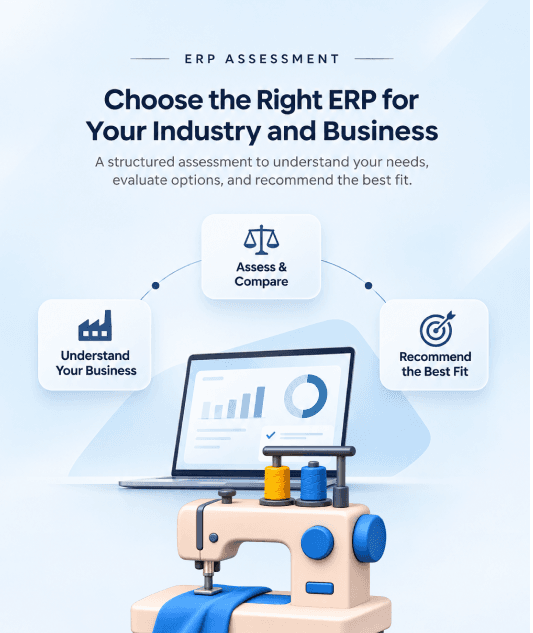
How Dynamics Square Implements Fashion ERP
Our fashion ERP implementation in Canada follows Microsoft's Success by Design framework for Dynamics 365 projects.
Discover
Dynamics Square studies how your teams manage styles, sizes, fabric lots, subcontractors and shipping. This helps us understand your current processes and identify areas that need improvement.
1
2
Initiate
We confirm the project scope, select the right Dynamics 365 system and assign responsibilities. This ensures everyone knows who manages product, material and size records.
Implement
Dynamics Square configures product variants, bills of materials, production steps and lot tracking. We also import existing records and open orders and connect labelling and EDI tools.
3
4
Prepare
We test a real production order from fabric cutting through finished goods shipping. Your team receives training, and we verify that fabric lots can be traced through production.
Operate
Dynamics Square supports your team after launch, particularly during seasonal demand, new collection launches and size range changes. This helps your business manage daily operations with greater confidence.
5
Dynamics 365 ERP Pricing for Fashion and Apparel Manufacturing
The table shows the 2026 Dynamics ERP pricing list with prices in Canadian dollars per user, per month. Additional apps for EDI or order entry, along with the number of full and occasional users, can affect the final cost.
Business Central
Essentials
From $108.50CAD/user/month
Finance, sales, purchasing and inventory with item variants
Premium
From $149.20CAD/user/month
The production tier, adding production orders, BOMs, routings, MRP and subcontract work centres
Team Members
From $10.90CAD/user/month
Occasional users who view data, approve requests and make light updates
Supply Chain Management
Standard
From $284.90CAD/user/month
Product dimensions, master planning, demand forecasting and advanced warehouse management
Premium
From $407.00CAD/user/month
Standard plus deeper analytics and financial planning
Implementation costs depend on the size and complexity of your project. A single factory using Business Central typically needs a simpler rollout, while Supply Chain Management across multiple plants requires more work to migrate product data, configure variants and set up production planning.
Get a Custom QuoteWhy Canadian Fashion and Apparel Manufacturers Choose Dynamics Square
60+ Manufacturing implementations and 35+ manufacturing and supply chain consultants bring practical industry experience to your ERP project.
With over 14 years of experience serving Canadian manufacturers, Dynamics Square understands bilingual labelling, provincial tax differences and supply chain reporting requirements.
Dynamics Square begins with your garments, size scales, tech packs and cut tickets. These details shape how the ERP system is configured to match your production needs.
Dynamics Square’s consultants hold certifications in both products. We compare their capabilities against your requirements and recommend one suitable option, even when the simpler system is the better fit.
Our support continues after launch through seasonal peaks, new collection launches, contractor changes and revised size scales. This helps your team manage changing production needs with confidence.
Frequently Asked Questions
Yes, Dynamics 365 supports key clothing business processes, including style management, fabric purchasing, production, warehousing, wholesale orders, online sales and financial management. Business Central suits smaller manufacturers with established product ranges and a limited number of sites. Supply Chain Management suits larger businesses managing extensive catalogues, more product dimensions and factories across multiple provinces. Power BI and Excel can use shared business data to help merchandising, production and finance teams work with consistent figures.
Dynamics 365 helps manufacturers track clothing by style, colour and size. For example, a rain jacket available in four colours and six sizes has 24 possible combinations. Business Central records these combinations as variants under one item, with codes used across sales, purchasing and inventory. Supply Chain Management supports colour, size, style, configuration and version as product dimensions. Teams can generate the combinations they need. Dedicated partner apps can also provide grid screens for entering orders across multiple sizes quickly.
Cut-and-sew work gets scheduled and costed in both products, using routings that move a jacket from spreading to cutting, sewing, pressing and finishing, and scrap allowances on material lines. Business Central assigns an operation to a work centre tied to a vendor and produces subcontracting purchase orders from the routing, using transfer orders for material that leaves and returns. Supply Chain Management builds vendor operations on service products and adds a Subcontracted work list, delivery notes and warehouses that the vendor manages. The contractor's charge lands on the production order, so garment cost reflects it.
Business Central offers a Sales and Inventory Forecast extension that uses historical sales to estimate future demand and suggest replenishment. Planners may need to distribute these estimates across colours, sizes and locations based on expected demand. Supply Chain Management supports statistical forecasting, including machine learning-based options where configured. Planners can review forecast accuracy, adjust estimates and use approved forecasts for material and production planning. For new styles with limited sales history, buyer estimates and sales patterns from similar products remain important.
Implementation costs depend on the number of factories, product range and quality of existing product and supplier records. Additional users and connections to electronic data interchange (EDI) or labelling tools can also affect the overall cost. Dynamics Square assesses these requirements, identifies the necessary integrations and prepares a project quote based on your business needs.
Know Which Fabric Lot Is in Every Garment Before a Buyer Asks
Give planners, cutters and warehouse staff one set of numbers from the first roll of fabric to the last carton shipped.
Book a Free Consultation Today