Why Plastics Manufacturers Trust Us
60+
Implementations in Manufacturing
35+
Manufacturing and Supply Chain Consultants
14+
Years Serving Canadian Manufacturers
Dynamics 365 for Plastics Manufacturing: Business Central or Supply Chain Management
Dynamics Square recommends two ERP options for plastics manufacturers: Business Central and Supply Chain Management. The right choice depends on your production processes and plant requirements. Both ERP systems connect purchasing, material receiving, production, quality checks, inventory, shipping and finance, helping track resin costs through finished products.

Dynamics 365 Business Central
Business Central is a practical choice for injection moulders, extruders, thermoformers and manufacturers making containers, fittings and housings. It works well for businesses producing established products across one or a few plants. Key features include scrap tracking, resin lot numbers, incoming material inspections, machine scheduling and material planning.
Explore Business Central
Dynamics 365 Supply Chain Management
Supply Chain Management is designed for compounders, colour and masterbatch blenders, film and sheet manufacturers, and processors operating across several locations. It supports material formulas, batch tracking, recovered materials, production scheduling, equipment maintenance and shop floor reporting.
Explore Supply Chain ManagementCustomers and inspectors assess manufacturers through their quality processes, test reports and supplier records. Dynamics 365 helps maintain the material, inspection and production history needed to support these documents.
Match My Plant to a ProductWhat Compliance Requirements Must Plastics Manufacturing ERP Meet in Canada?
Five areas of Canadian regulations and customer requirements affect the records plastics manufacturers must maintain. An ERP system helps organise material details, production records, recycled content data and quality documents needed for reporting and customer audits.
Federal Plastics Registry
Under the Canadian Environmental Protection Act, 1999, Environment and Climate Change Canada collects information about plastic products placed on the Canadian market. Manufacturers must report product categories, resin types, recycled material sources and quantities by weight. Businesses handling less than 1,000 kilograms annually are exempt. Monthly material records help prepare accurate reports.
Single-use Plastics Prohibition Regulations
Canadian regulations restrict six categories of single use plastics: checkout bags, cutlery, foodservice ware, stir sticks, straws and ring carriers. Manufacturers must account for restrictions on their manufacture, import and sale. Marking restricted products in the ERP item records helps purchasing and sales teams identify prohibited items and avoid processing orders for them.
Food Packaging Under the Food and Drugs Act
Section B.23.001 of Canada's Food and Drug Regulations prohibits food packaging that may transfer harmful substances into food. Health Canada may issue a Letter of No Objection after reviewing packaging safety, although this is not formal legal approval. Recording resin batches, material compositions and formula versions helps manufacturers identify which materials went into each shipment.
Environmental Claims Under the Competition Act
Environmental claims about products must be supported by adequate and proper testing. Claims about a business's environmental benefits require adequate and proper substantiation under the Competition Act. Following amendments through Bill C-15, internationally recognised methodologies are no longer specifically required. Tracking recycled resin, virgin material and production quantities helps support recycled content claims.
Customer Quality Requirements
Automotive customers commonly expect IATF 16949 certification and production part approval process (PPAP) documents. Medical, food and consumer goods buyers may request material certificates and batch traceability records. Linking resin batches with inspection results, production orders and shipments helps manufacturers answer customer questions, investigate quality issues and prepare audit documents more efficiently.
What Dynamics 365 for Plastics Manufacturing Needs to Do
An ideal plastics ERP should quickly answer questions about production: which resin batch went into a part, which order and machine produced it, and what quality checks found. Dynamics 365 connects these records, helping teams trace materials, investigate problems and understand production costs.
Resin, Additives and Packaging Lots
Record resin, masterbatch, additives, fillers and packaging as separate inventory items. Assign lot numbers when materials arrive, making every bag, container or bulk delivery traceable. Production orders record the batches consumed and link them to finished products. Teams can trace supplier lots to customers or investigate complaints back to the original resin.
Formulas and Recipe Versions
Business Central uses production bills of materials to list the materials needed for each product. Different versions help manage recipe changes, with approval controls determining which versions production can use. Supply Chain Management offers formula management, allowing manufacturers to define ingredients by quantity or percentage and record additional products recovered from production runs.
Batch Properties
Supply Chain Management can record test results such as melt flow rate, moisture and density against individual batches. Planners can select or reserve materials based on these values, helping ensure the right resin goes into each production run. Teams can also combine batches of the same product when their material requirements allow.
Incoming and In-Process Quality
Business Central can support inspections when materials arrive, and production output is recorded through its Quality Management solution. Failed batches can be held back from use, where configured. Supply Chain Management offers quality orders and sampling plans for manufacturers requiring regular checks, including initial production inspections and tests during manufacturing.
Press, Line and Mould Scheduling
Both products support production planning through machine capacity, working calendars and defined production steps. Material requirements planning helps calculate what materials are needed. Supply Chain Management adds master planning for more complex operations, helping manufacturers coordinate production orders, delivery deadlines, machine availability, mould requirements and resin supplies.
Tooling and Maintenance
Record moulds, dies and presses as assets to keep their maintenance history organised. Supply Chain Management's Asset Management module supports maintenance schedules based on time or usage, such as machine shot counts. It also manages maintenance work orders and repair costs, helping manufacturers monitor equipment condition and plan servicing.
Scrap, Regrind and Waste
Production planning can include expected material waste through allowances in bills of materials and routings. Business Central records actual scrap separately from good output, with reason codes where configured. Supply Chain Management can return recovered regrind to inventory as a co-product or by-product, helping teams track waste and material recovery costs.
Shop-Floor Reporting and Analytics
Supply Chain Management allows operators to record production progress directly from the factory floor using its production execution interface. Power BI and Excel can analyse shared business data, helping managers compare scrap by machine, production yield by job and profit margins by finished product.
Business Central vs. Supply Chain Management for Plastics Manufacturing
The two options provide a quick comparison, while the table below explains their differences in more detail. Use it to compare their features with your production needs or discuss the options with your team.
| Aspects/Parameters | Business Central | Supply Chain Management |
|---|---|---|
| Best suited to | Custom moulders, extruders and thermoformers | Compounders, blenders, film and sheet producers, multi-site processors |
| Production approach | Production orders from BOMs and routings, on the Premium licence | Formula-driven process production, plus discrete orders when needed |
| Recipe handling | Production BOM versions marked certified before use | Formula versions go through approval, then activation |
| Lot traceability | Item tracking codes issue and follow lot numbers | Batch numbers carry attributes and can be merged or reserved by attribute |
| Scheduling | MRP, with work and machine centres on calendars | Master planning and finite capacity scheduling |
| Scrap and regrind | Percent allowances on BOM and routing lines, with scrap codes at output posting | Allowances on formula and BOM lines, with operators reporting loss at the press |
| Co-products and by-products | Configured by your implementation partner | Supported natively, with cost split across outputs |
| Tooling and press care | Fixed asset records, or a partner maintenance app | Asset Management, with maintenance triggered by cycle counters |
| Quality | Quality Management module that blocks suspect lots | Quality orders, sampling plans and non-conformance cases |
| Company footprint | One mid-sized operation | Entities, plants and currencies across a group |
| Starting licence (Canada) | Premium: $149.20 CAD/user/month | Standard: $284.90 CAD/user/month |
Business Central Premium works well for manufacturers using established material lists and production steps across one or a few plants. Supply Chain Management is better suited to formula-based production, recovered by-products, usage-based mould maintenance, shop-floor reporting and businesses operating several legal entities.
Equipment such as dosing units, hopper dryers, machine controllers, weighing scales and label printers usually connects to Dynamics 365 through integrations or partner tools. During discovery, Dynamics Square identifies each device and the information it exchanges, ensuring machines and labels use consistent material, batch and production records.
Get a Platform RecommendationHow Does Dynamics Square Help You Find the Right Fit
A contract moulder managing hundreds of parts, a compounder following specific material recipes and a film manufacturer running several production lines have different business needs. The right ERP for plastics manufacturing should reflect how your plant operates, not force your team to change established processes.
Dynamics Square assesses your production methods, including moulding, extrusion and compounding, along with your product range, formulas and number of plants. We also examine regrind recovery, mould maintenance and customer audit requirements. Choosing a system beyond your actual needs adds cost and implementation time, while a basic system may leave recipes, scrap records and mould histories in spreadsheets.
Book Your Free Fit Assessment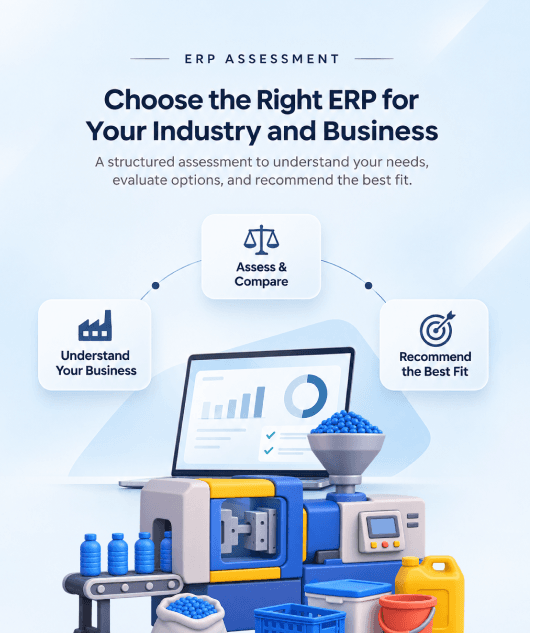
Plastics ERP Implementation in Canada: How Dynamics Square Does It
Dynamics Square follows Microsoft's Success by Design approach to implement Dynamics 365 for plastics manufacturers. The process covers five stages, starting with understanding your plant and ending with support after the system goes live.
Step 1: Discover
Dynamics Square studies your plant, from material receiving to production and regrinding. The team learns how you manage resin, moulds, tooling and production waste.
1
2
Step 2: Initiate
Dynamics Square confirms the project scope, selects the right ERP product and assigns responsibility for maintaining material, recipe and mould records.
Step 3: Implement
At this stage, we configure material records, lot tracking, production steps, scrap codes and costing. The team also transfers product, supplier and open order records and checks them against your existing data.
3
4
Step 4: Prepare
Next, we train your team and tests actual production jobs, from resin receipt to finished goods shipping. The team also checks whether a resin lot can be traced to every customer who received the finished products.
Step 5: Operate
At this stage, Dynamics Square supports your team after launch through new tooling installations, material changes and customer audits. This helps keep production and inventory records accurate as your operations change.
5
The first workshop also defines how materials and scrap will be recorded, as these details directly affect production costing and reports.
Dynamics 365 ERP Pricing for Plastics Manufacturing
The figures mentioned below reflect the suggested retail prices for Dynamics 365 in Canadian dollars. Additional tools for weighing scales, blenders and mould monitoring, the number of regular and occasional users, and implementation requirements can affect the final cost.
Business Central
Essentials
From $108.50CAD/user/month
Finance, sales, purchasing and inventory with lot tracking
Premium
From $149.20CAD/user/month
Essentials plus production orders, BOMs, routings, MRP and Quality Management
Team Members
From $10.90CAD/user/month
Light access for approvals, lookups and small edits
Supply Chain Management
Standard
From $284.90CAD/user/month
Formula management, master planning, quality orders, plus Asset Management
Premium
From $407.00CAD/user/month
Standard plus advanced analytics and financial planning
A Business Central implementation for a single-site plastics manufacturer involves a simpler setup. Supply Chain Management across several plants requires more work to transfer and configure product records, material formulas and equipment maintenance history. The final implementation cost depends on the number of sites and the complexity of your operations.
Get a Custom QuoteWhy Canadian Plastics Manufacturers Choose Dynamics Square
Across 60+ completed manufacturing implementations, our team of 35+ manufacturing and supply chain consultants has gained hands-on experience with different production environments and operational challenges.
Dynamics Square begins by understanding your shop floor, including resin handling, colour changes, regrind and tooling. These details help us configure the system around your actual production processes.
You receive one clear product recommendation, either Business Central or Supply Chain Management, with reasons based on your business needs. If Business Central is enough, we recommend it rather than a more complex system.
Our consultants hold Microsoft certifications across both products. This means your guidance comes from professionals who understand how to configure and implement each system.
Our support continues after launch through new product introductions, resin changes, mould replacements and customer audits. We help your team manage changing production requirements and maintain accurate records.
With over 14 years of experience, Dynamics Square understands Canadian manufacturing requirements, including provincial tax differences and relevant regulatory reporting. This experience helps us identify important requirements before implementation begins.
Frequently Asked Questions
Yes, Dynamics 365 helps Canadian plastics manufacturers manage purchasing, resin batches, production, quality checks, inventory, shipping and financial records in one system. It also supports Canadian tax requirements, including GST, HST and applicable provincial sales taxes. Business Central works well for moulders, extruders and thermoformers operating a few plants. Supply Chain Management supports formula-based production and larger, multi-site operations.
Dynamics 365 helps manufacturers control which materials and quantities go into each production batch. Business Central uses production bills of materials (BOMs), with different versions and approval controls to manage recipe changes. Supply Chain Management offers formula management, allowing ingredients to be measured by quantity or percentage. It also records co-products, by-products and batch test results, such as moisture and melt flow rate.
Yes, Dynamics 365 tracks resin, masterbatch and additives through lot or batch numbers. When production consumes specific material lots, records link those materials to the finished products. The tracking continues through inventory transfers, picking and shipping. Manufacturers can trace a supplier's resin batch to the finished products and customers who received them or investigate a returned part back to its original material.
Dynamics 365 records expected and actual production waste through its manufacturing features. Both products support planned scrap allowances in bills of materials and production routings. Business Central records actual scrap separately from good output, using reason codes where configured. Supply Chain Management offers shop floor reporting and can return recovered regrind to inventory with an allocated cost. Reports can help compare waste by part, machine and reason.
Business Central Premium is a practical choice for manufacturers using established material lists and production steps across a few plants. Supply Chain Management is worth considering for formula-based blending, valuable by-products, multiple companies and advanced equipment maintenance. Dynamics Square reviews your products, production processes and plant requirements before recommending the appropriate system.
Know Which Resin Lot Is in Every Part You Ship
Traceable lots, visible scrap and job costs you can rely on, so margin stays steady order after order.
Book a Free Consultation Today